Tuesday, June 4, 2024

My Method for Research


Blog

I was recently asked about my method(s) for researching the cultures of my characters, their settings, and the times in which they dwell. Although I’ll mention examples from more than one source, my focus will primarily be upon research into and decisions made regarding Wat Haggard & Prairie Wren.


The idea of a modern-day crime novel around an aging, rural sheriff was developed in discussion with my son, Tony, an actor seeking an idea for a script. When he bogged down in developing the idea, I decided to run with it. In order not to “steal” the story from him, I decided to move it far away from his California locale.

I chose western Nebraska for its prairie terrain, particularly around The Sand Hills. Working with a map, I chose two more sparsely populated, contiguous, north-south counties I then renamed. The southernmost county contained a National Wildlife Refuge, also renamed, which I decided to incorporate into the story. In the process, primarily online, I researched terrain, agriculture, population density, principal towns, town governance, policing, and seasonal climate, the latter important since the story was set in December. When uncertain, I allowed imagination to take over. For me, once a choice of location has been made, characters assume dimensionality.

Relative to antagonistic characters, I thought of the reality of workforce reductions in the Bakken Oil Fields after production cutbacks and where they might go for those that live peripatetic lives. The roughness of the antagonists I imagined from the impact the itinerant workers had upon the small, North Dakota towns where they settled, the kind of characters a sudden economic boom can draw – many good hard-working people, but some less than. The character of Prairie Wren was developed from my awareness of the abuse (and worse) of too many indigenous women, many missing, some even murdered.

If an informational gap remains after my online efforts or a clarification is needed, I will make a telephone call to an appropriate organization. Example: In Where Seldom Is Heard, the setting an unnamed Indian reservation on the North Dakota / South Dakota border, I made a call to the Standing Rock Indian Reservation’s governmental office. To my surprise, it was answered by the Tribal Attorney who hesitantly, but generously answered my pre-written questions.  Example: In Its Just Another Day, after I had exhausted my online efforts to research the Newport News, Virginia coal port, I placed a blind call to the port. I cannot recall the official I spoke to, but again, after an initial hesitance, he kindly answered my pre-written questions regarding the loading process of an ocean-going coal carrier.

Please notice the underlined “pre-written.” For me it was a necessity I’d recommend to others. When an opportunity presents itself, do not try to wing it; rather, be ready.

Thursday, March 21, 2024

RJ Mcarthy Releases Another Crime Fiction Novel


Quis Auxilium Me (Somebody Help Me) is set in 1963. Shortly before his seventeenth birthday, Sean Thornton overhears a confession of an imagined crime by one of the town’s bumper crop of bullies, Rocky Corcoran. A week later, the crime – the violation of a friend’s mother – is committed. Suspended between the immediacy of his teen years and the onrushing responsibilities of a looming adulthood, Thornton struggles with the guilt-laden weight of his Catholic-bred conscience. Testing Thornton’s mettle, for reasons unknown, Corcoran has always nursed a particular dislike of Sean.

Torn between doing the right thing and avoiding Corcoran’s wrath, Sean turns to Police Officer Britt Clarity, one of the first female officers in the Suffolk County Police Department. Clarity is battling her own internal torment, attributable to the resistance of male officers to her presence. Her determination to succeed and her increasing self-defense mastery of aikido enable her to maintain confidence through the disrespect and to concentrate on doing her job well.

 McCarthy masterfully builds his characters as he creates windows into their souls so that the reader is torn between empathy for the antagonist and wanting him brought to justice. McCarthy weaves in glimpses of the backstory that made Rocky who he is. The struggle between good and evil keeps the reader turning the pages of Quis Auxilium right up to the end.

 When asked what inspired me to write this story I answered, "If inspiration is something that comes with the suddenness of a spring gust blowing off your hat, then that could describe the arrival of Quis Auxilium Me. It sprung from the idea of an overheard confession. What-ifs swiftly followed like the bits and pieces from which a bird builds a nest. In this case, I guess I was the bird, my bits and pieces drawn largely from scattered yet poignant childhood memories."


Quis Auxilium Me
(Somebody Help Me) is available on Amazon.com in paperback and in Kindle e-book versions: Quis Auxilium Me: (Somebody Help Me): McCarthy, RJ: 9798878637824: Amazon.com: Books


Wednesday, July 12, 2023

Blog 48 Who is Tony Quarry?


With the release of Quarry Steps Between, the fourth in the Tony Quarry / Carolina Mystery crime novel series, someone asked me about the derivation of the Tony Quarry character. Who is he? How was he developed? In retrospect, I believe he’s an amalgam of my son, Tony, and me.

Physically, Quarry is similar to my son in his twenties and thirties. Massive at six feet, two hundred thirty pounds, my son was quite strong, a weight lifter and martial arts practitioner. As important as physical strength is to the character I envisioned, it was ultimately potentiated by moral strength. One without the other, in my mind, equals an incomplete human being.

I’ve also been a weightlifter, have seriously practiced karate, Quarry’s primary method of self-defense. As a convicted felon, Quarry is not legally permitted to carry weapons.

That said, life for me, among other things, is a battle to retain moral strength, to remain dedicated to trying to do what’s right. Hence, Quarry. For me, doing the right thing is not a relative decision; we know what is right. Sometimes, some of us may choose to do otherwise, but we still know. Morality is something that can too easily slip away, succumbing to the never-ending temptation toward moral laziness. It’s about seeing honestly what lies before us. It’s about constantly renewing self-honesty. Without that, how can one ever be honest with others?

Moreover, morality is about having a sense of where you stand on human issues. From a platform of strength, it’s about offering empathy and mercy to the world around you, if nothing else then through small, individual acts as opportunities present themselves to you. It’s about trying to do good. It’s about a never-ending struggle for forgiveness, both giving and accepting. Above all, it’s about a willingness to try, a protection against giving up. All of the above thread through plotlines of the series, providing Quarry compass as he faces his challenges.

Crucial to my fiction, to my protagonist, Quarry, he cannot be a one-dimensional figment of my imagination. Otherwise, he could just be another Marvel Universe super-hero. No, pre-eminently, he must be credible. I’ve got to be able to believe that he can exist, all over the world and in my neighborhood. Maybe, even in my house.

And in the end, perhaps ironically, my protagonist succeeds by just doing what he’s supposed to do – what we’re all supposed to do.

Available on Amazon!

Friday, June 23, 2023

Blog 47 A Return to the Issue of Banned Books


With the reader’s indulgence, I’d like to return to the central issue of last month’s blog – book banning. As a resident of Virginia, I believe Governor Glenn Youngkin serendipitously latched onto an issue that carried him to the governorship, i.e. parental involvement in the public education of their children. The upside has been exactly that – parents seeking increased awareness of what their children are being taught. Of a concern (my opinion), a vocal group of parents protesting specific books found in school libraries relative to content of which they disapproved, have pressed to have those books banned. The books in question appear most often to have addressed issues related to sex, race or LGBTQ life. My sense: More often than not, the material objected to has been separated from a more complete contextual understanding.

Am I questioning the sincerity of parental concern in these matters? I am not. Do I fear a good, if misguided, intention gone awry? As I stated in my last blog, I do not believe banning a book is the answer to valid parental concern. Unless a child’s mind has been adulterated by the “adults” in charge of his or her development (all too common, I fear) or unbalanced by a genetic flaw or environmental injury (rare to my knowledge), I believe this recent uptick in concern that a particular book will warp a healthy child’s mind is imbedded in adult fear and its co-rider, ignorance.

As I did in the previous blog, permit me to use myself as an example of a legitimate concern distorted by ignorance. In my professional career, I was a Clinical Psychologist, a believer in knowledge gleaned from, among many things, hundreds of books I devoured. And yet, I fell prey, in a way, to this issue, allowing concern and ignorance lead me to make comments to my son in his early teens regarding his love for and pursuit of science fiction. For years, he’d read voraciously, but narrowly as it appeared to me. I pressed him to broaden his reading experience. In subsequent years, I was humbled to learn what a broad and deep swath of learning he’d extracted solely from sci-fi, including ideas about sex, race and the necessity of living with others different from him.

Coupled with my embarrassing admission that I’d avoided science fiction as a reading interest and therefore had rendered myself ignorant of it, I’d committed the same error in prejudgment I’m writing about here. Concern without knowledge could be a starting point leading to an option to educate oneself. Conversely, concern leading to emotional reaction without knowledge would seem premature at best, subject to diminishing parental effectiveness or worse.

So then, what is one to do when faced with a valid concern regarding the books our children might read? I do not believe the answer is to begin banning books. Beyond ourselves and teachers as sources for discussion about books our children read, one option I’d like to reiterate is to turn to the members of our society we’ve educated and trained to curate the books our children are exposed to for direction – our librarians. They can either appropriately guide us to the reading experiences we seek or to materials that offer in-depth reviews of the books we’re concerned about. When in doubt, let’s put our heads together with them.


Tuesday, June 6, 2023

Blog 46 - Banned Books


Blog 46

The frustration has ebbed, for now. I can think more calmly, a personal requirement whenever I attempt to address a sensitive issue with political overtones. In this instance, the issue is book banning.

Sometime in the late 1950’s, D. H. Lawrence’s Lady Chatterley’s Lover was published in the United States, although bootleg copies published in newspaper format had been available years before. The sexual content was considered pornographic by American censors, primarily the Catholic Church. My mother, a college-educated progressive (in selective ways) obtained a copy, but asked me not to read it, even as she did. Her rationale, as best as I can recall: She wanted me to be able to discover my own emotionally-satisfying sexual life without having it scripted for me. I’m putting it that way to be kind toward and respectful of her intentions, although in retrospect I question them.

I was fourteen at the time, my thoughts and dreams often sexually driven. In some ways, she was too late. I hungered for anything that might further reveal or clarify this veiled fundament of life, the thing in fact that propelled it. The more knowledge of it was hidden, the more obsessive the impulse to know became.

An irony: My mother was a believer in books. At eight, she’d given me a thin pamphlet describing the biological facts of sex, shorn of any accompanying emotional explication. When it came time to give me “the talk,” she quailed and left me with the book and her faith in it. My father remained in another room during. Another irony: At eight, I had no conscious interest in sex and, therefore, was unable to formulate the questions she avoided. I was able to detect her odd discomfort in discussing the issue. A year later, at nine, my interest in females began, but the opportunity was gone and I wasn’t about to reintroduce it.

From these incidents, I became more aware than ever that, as a whole, it’s the adults who struggle with books, not children. As if banning them could ever erase the curiosity the issues arouse. Want to create a best seller? Ban it. You’ll send it underground to become a “cult” classic. Look at the samizdat industry in Soviet Russia. The communists could never extinguish it. I only wish most adults who seek to ban a book would read it first, in its entirety, the parts they object to in context, prior to.

It appears it’s never enough for some parents to object to a book out of concern for their children, their concerns often framed in religious or moral terms. I could accept it if they would act on their beliefs for their children and leave it at that. When they want to extend the impact of their personal concerns to ban what your children or mine read, then I have a problem.

This is the basis for cultural war. Do it loud enough and you may capture political attention. Politicians are always casting about for an issue that might strike a note among constituents. Once found, they’ll stir it to see if it bubbles up into a potential campaign plank. If it does, they’ll proceed to flog it. For them, it is foremost about getting elected. Whatever works, right? The problem? The rest of us are left with the aftereffects, including the unintended consequences, e.g. the right to decide for our children narrowed, eliminated or criminalized.

Currently, there are those who want to protect our children from anything historical that might make them uncomfortable and from anything that might help them understand their own emerging sexual feelings before we’re ready for them to. Our solution: To start by banning books which make us uncomfortable.

The Nazis took it a step farther and burned books, turning the act into a political spectacle. My mother knew this. In retrospect, I believe she was simultaneously trying to do something and not do it, i.e. trying to protect me from something she could not bring herself to fully explore, much less explain.

I see a parallel with book banning – parents trying to do something they believe will protect their children and not doing it by failing to understand what a book can and cannot do, and ultimately, by failing to trust our teachers and librarians. Beyond embattled teachers, our librarians represent a group educated to curate for us the books time alone will never allow us to read – which is most of them.

To me, the risk that a child will be adversely affected by a book is miniscule when compared to the increasing risk that same child will be slaughtered by a military weapon in a place that values book learning – a school.

Your thoughts?


Tuesday, April 18, 2023

Percolating


Blog 45

Currently, I’m sitting on a story idea while it evolves in my mind. When I say “sitting,” I don’t mean anything akin to idling. Percolating would be more apt. My process for original writing is in motion as several pages of notes would suggest, if not attest.

The development of the idea appears to be emerging slowly, perhaps more so than usual. As such, it has afforded me an opportunity to examine aspects of my writing process. I’ve read of writers who claim to allow their story to come forth “organically.” I interpret this, correctly or not, to start writing and see what transpires. Contrast that to the crime writer I met at a workshop years ago who tightly plotted his efforts down to an anticipated number of chapters and pages per.

If those examples represent the extremes, I’d locate myself somewhere in between. I typically have a plot in mind, nebulous as it might be, with a beginning and an end. Whether I can get there or not, I need to have a sense of destination. While it is not inlaid in stone and is ever subject to alteration, I feel the need for a vision of the story’s conclusion even as I begin.

In my present state, an aspect of my “percolating” relates to an unusual struggle with the decision to narrate from a first-person point of view or my generally more comfortable third person perspective. I’ve found myself pondering what this might be about. Though I have no answer, since I’ve found myself tilting toward first-person this time, I’m wondering if there’s a lurking concern with interjecting too much of myself into the main character.

Feel free to laugh. Of course, there are always pieces of me scattered throughout my fiction. As with any writer, how could there not be? It (all of it) issues from my head. That said, my experience suggests the closer a character approaches me (or I him), the greater the possibility that fiction is edging into autobiography. I’ve also noticed that the nearer my path attenuates toward the protagonist’s, the more my writing slows. Am I now entertaining decisions to withhold in order to maintain privacy? And if so, is honesty being sacrificed for my comfort?

Weird? Silly? Your thoughts or experiences?

Thursday, March 16, 2023

Blog 44 Wee Geordie

 When I was a young boy, I tended to see myself as puny, wished I was larger, stronger, more capable of standing up to the bullying world I inhabited. In retrospect, I wasn’t as diminutive as I imagined, but, correctly or incorrectly, our brains tell us what our eyes see and the malformations of self-perception loom.

In the midst of those formative years, I saw a movie, Wee Geordie, about an undersized Scottish lad who built himself into a behemoth through years of diligent exercise. Geordie went on to win an Olympic gold medal in the hammer throw. The movie, a thunderbolt to my heart, touched my uneasy sensibilities. I loved it. From my late teens through my thirties, I worked dedicatedly to building strength. To this day, at eighty, my exercise regimen includes resistance training.

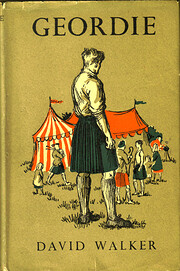
For reasons unclear to me at the moment, I recently thought of the movie, recalling the joy it brought me at a time of self-doubt, found myself wondering if it was based on a book. It was. A brief online search revealed Geordie, a novel, was written in 1950 by a Scottish writer, David Walker. I knew I wanted to read it. More research revealed several copies were available through Biblio, a British seller of antiquated books. With the help of my considerably more computer savvy son, a copy was procured at a reasonable price. The first edition copy arrived in far better condition than I’d anticipated by Biblio’s description, down to an intact original dust jacket.


All that aside, I read the story (192 pages) in two days, the book even more enjoyable, more moving than my memory of the movie. More than the unidimensional, triumph-of-might tale I recalled, Geordie was (is) an almost magical love story, the love propelled and enabled by Geordie remaining true to himself despite worldly temptation.

Sound like a fairy tale? In some ways it came close. Today, it would probably be viewed as a YA novel, although I would demur in that categorization. I found the author’s deceptively simple writing almost poetically beautiful, his control of the story he wrote masterful.

            The wonder of books! How lucky I am!

Thursday, February 23, 2023

Watch Your Vocabulary


Blog 43

I received an unexpected letter earlier today. It was from a former colleague I haven’t seen in forty-five years though we have remained in touch – exchanged cards at Christmas, the decreasingly occasional letter, kept up with extended family developments. Apparently, Sandy had purchased and read my latest publication, the story collection, Uplift: Sunrise Stories. The thrust of her letter was to share the impact of the stories.

Her subsequent critique was sobering, leading me to reflect upon my writing, never a bad idea. As a young writer, feedback – especially unrequested – left me nervous, ill-at-ease, likely defensive and possibly even prickly. This time, I leaned into it, able to digest her feedback with minimal anxiety. An advantage of age? Maybe. Overall, her impressions were positive as she indicated how several of the stories had affected her. Knowing her, I was unsurprised at the stories she was most comfortable with.

What struck me most was the difficulty she reported with my vocabulary. This startled me. As an incipient writer fifty years ago (likely more than), I had a tendency to deaden my creative efforts with turgid vocab. My initial effort at a novel was so over-weighted, so swollen, so wordy, as to be unreadable. It has remained (and will remain) unpublished. Gradually, with dedicated effort, I’d worked assiduously to sand away the weighty words for the sake of the reader’s reading rhythm. Anything that interferes with reading comfort has the potential to flatten a story. Remove the pleasure of reading a story and you are left with what? I thought I’d put that tempo-destructive problem behind me.

It is my belief that chosen language must always be appropriate to the type or genre of writing and the reading audience. Without language sensitivity appropriate to the expectations of one’s readers, exactly who is the writer writing for? At essence, language is what it is all about, the tool for effective communication. And who decides what is appropriate? The reader. The reader decides. Sandy decided.

I plan to write Sandy, to thank her not only for purchasing my book, but for her generous feedback. I will be more closely examining my most recent efforts under the lens of her experience. I also plan to check with a few fellow writers as well as other readers to see how Sandy’s experience compares.

Uplift on Amazon

Monday, January 16, 2023

Review of The Rabbit Hutch


Blog 42


Though I still read novels to be educated, at this point in my life, the tilt is toward the element of entertainment. I want, above all, to enjoy the story I’m reading. With that in mind, though I still read literary novels (a personal requirement), I have less patience if the one I’m reading turns into a slog.

I recently completed Tess Gunty’s The Rabbit Hutch, a highly regarded 2022 release. Set in and around an apartment building in a moribund, rust belt Indiana town, time and circumstances (among them, loss of a single industry) have left the town and its occupants behind, adrift and forgotten. The dislocation of the younger adults without educations through which to advance, but still needing to find a path to a life of purpose, now idling, amusing themselves with terraced cruelty stands in contrast to the aloneness (more than loneliness) of the older adults with their peculiarities and proclivities that could slip into madness.

Through it all is Blandine, a preternaturally intelligent, seventeen-year-old, knowledgeable beyond her years, beyond the other characters, yet damaged by institutional failure, i.e. a foster care child now aged out of the system. Her planned escape from her body (from life?) culminates in insulting to rage a shy, emotionally underdeveloped boy to try to kill her – suicide by inviting murder. That she survives offers a (tiny) glimmer of hope.

My sense is that the author is sympathetic toward the plight of these characters abandoned by society and circumstance, to the waste of lost potential and what can befall individuals not part of or connected to a system, toward those institutionally failed, left to disconnected lives of loneliness without clear purpose or a sense of options, particularly the young, thrust into the world unprepared for independence and without support.

I came to this book, as I do all fiction, hopeful for a story that would filter in and linger like the aroma of warm bread. Rather, I closed the book upon completion, thinking, “What was that?” Rather than the lift of just-baked bread, a weight sat upon me like regret.

Perhaps (probably) the problem (fault, failure), if that’s what it is, lies with me. I may lack the analytic skill to appreciate, more fully, the author’s intent. In the end, I did not find myself identifying with or, more importantly, pulling for any of the characters, not even Blandine. But then, maybe that was, at least in part, Gunty’s point – not enough of us do root for the dispossessed, manifesting concern about vitalizing (or revitalizing) their lives.           

If you happen to read The Rabbit Hutch, and respond differently, please guide me to what I missed.

Wednesday, December 14, 2022

Blog 41 In Between Projects


Currently, I’m in-between projects following the release of my first published story collection, Uplift: Sunrise Stories. I’ve heard the expression “between projects” often. Taken out of context, it might sound a bit stuffy. Might it suggest, however, a fallow period, a time of rest or something else, some time away from writing, perhaps? But what does the term mean to me?

The closest I can come to something definitive is that I’m weighing a decision regarding ideas for a new direction and not suspended between project ideas. The former hang from my brain like ever-dripping stalactites. A mind in motion, always. Gift or curse? Depends upon the day.

As I have in the past when I’m “between projects,” I pursue two parallel tracks on an almost daily basis. The first, I view as an opportunity. I review, re-edit and update unpublished work. One might compare it to an athlete, which I once was, practicing between competitions to retain a conditioned ability. Viewed this way, it could suggest that writing, at least some aspect of writing, is an everyday activity and not just one that arrives in inspirational bursts. Whatever one might think, this is the way it is for me.

The second track is less definable, more nebulous, but, for me, just as important. I try to remain ever alert to possibility when it serendipitously offers itself. The catalysis of an idea lies all around, always, the world speaking to us in myriad ways. It might blast forward in a roar (war crimes in Ukraine) or it might shudder forth in a whisper (the wine-tinged revelation of a slightly inebriated person at a Christmas party). But it’s there, in the news, in my city or neighborhood, in something someone says, an expression (original or trite), in a single word somehow housed in an otherwise forgettable context, in a gesture (essential or familiar, or both simultaneously), in a sensory experience triggered by art whether a painting, a song or a satisfying book. When it comes, and it will, I seek to get it, to get something, on paper ASAP.

How do you manage the in-between?

Tuesday, November 15, 2022

Politics in Reading and Writing


Blog 40

When it comes to politics, does contemporary fiction tend to eschew it, embrace it or land somewhere in-between? Judging from a limited (but growing) sample over the past few years, I’d say somewhere in-between. Now I’m not referring to a work whose sole purpose is to propound a political position. I’m sure they’re out there; I just avoid them, if possible.

My requirement to keep reading when I encounter a political element in fiction is that it remains necessary to understanding a character. Beyond that, I may close the book, wondering how it slipped under my radar. I’m exposed (over-exposed?) to enough politics via non-fiction books, newspapers, online information, etc.

What I’ve encountered in contemporary novels is a recent tendency for a character to express dismay over his or her perception of a negative impact of Donald Trump, whether it’s upon their psyche and personal outlook or their current sense of the state of the country. (Have I encountered an opposed position? I have not. I suspect at some point, I will.) What I’m discovering may say as much about what I choose to read as anything else. At the same time, it must be said that when I select a book, I have no way of knowing how the characters will develop or what views they may hold. After all, I’m choosing to read fiction with all the unknowns and surprises it can (and almost always does) offer. My sense is that fiction writers, human beings above all, are not impervious to a political zeitgeist, that the latter can infiltrate their thinking and emotions, no matter their intent in writing a story. Again, if the political stance is central to a character, no problem. If it’s a polemic, case (or rather, book) closed.

****

Last week, I finished Marrying the Ketchups (Jennifer Close), a novel about a Chicago family, disparate in personalities, but centripetally held together by the family restaurant, their love of the Chicago Cubs, and perhaps most of all, a sense of family and its importance in their lives. Powerfully from my perspective, I found myself drawn to and ultimately rooting for the characters, always a good sign for a reader. For me, Ms. Close, through her story, offered what I consider to be a quality nonpareil in leaving a reader satisfied – hope.

Strongly recommend.


Thursday, October 27, 2022

Blog 39 Reading and Writing


There are two topics I’d like to examine from this observer / participant in a reading / writing life: 1) what a writer reads during a writing project and 2) what a writer focuses on during the interlude between writing projects. Not infrequently, these are two questions asked in interviews with authors. And not surprisingly, I’ve found great variation in the answers offered. 

In considering the first query, to my knowledge, my reading selectivity doesn’t vary during or between writing projects. I’m a reader by nature, a reader who reads always. I often have two books at hand, most often a work of fiction balanced by a nonfiction work, the latter preferably narrative in structure.

During a writing project, the only alteration in my reading, by addition, is the readiness to pursue research at almost any moment. If an awareness of a need to pursue research crops up I’ll temporarily suspend the writing until I’m reasonably assured I’ve grasped a subject, especially if it is to be incorporated into a story, even if it is a single line. I like to know things, always have – knowledge for knowledge’s sake. But in addition, there is always a reader with a bent for exactitude somewhere ready to pounce on an avoidable error.

Example: I’d never heard of the animal sedative, xylazine, in the news recently. Apparently opioid / opiate addicts have begun to incorporate it into their endless search for chemical nirvana along with heroin and, more dangerously, fentanyl. An hour’s investment in an internet self-education session followed to heighten my knowledge.

As for the second query, the interlude between my writing projects, it tends to be brief. I’ve read of authors taking months or even years between major publications, for a myriad of reasons, but that just hasn’t turned out to be my way. Thus far, in my very humble writerly life, at a moment of publication, I usually have another major project roughly entered into the computer. (Not a recommendation, again it is just my tendency.) That said, the long journey of editing, for me a satisfying journey, always beckons. So, it is rapidly back at it after a quiet celebration of accomplishment.

And, of course, the reading, pleasurable and germinative, never stops.

Thursday, September 15, 2022

Blog 38 Reading Choices


I’d like to return to a theme of a previous blog in which I examined reading choices, book readiness, as a factor of the age of the reader. While I cannot, at eighty, ignore the impact of age in selecting a book, that is not my purpose in traveling this path once more. My thinking is more upon the appeal of a book as a function of what a reader is seeking at a given moment across the span of their lifetime.

Once more, I recall Isaac Bashevis Singer’s dictum that fiction is to educate and entertain. In my twenties and thirties, I read a ton of what is still considered classic literature. As I recall, I was seeking an education, rather than entertainment, in reading “great” works. I was going on faith. In retrospect, it’s good that I wasn’t seeking entertainment for I rarely found it. As for the education I sought in literature, did I find it? I don’t know. I do know much of the reading was a slog.

Though I still reach to further educate myself through reading, to challenge my knowledge base, I seek it primarily through non-fiction. The authors state their intentions and hopefully live up to them.

In fiction, the weight now in reading selection is more upon enjoyment, that book I cannot put down. If the author’s intention is to explore a topic within a fictional plot, the message must arrive in a satisfying story. I’ve been disappointed too many times by a critically heralded novel in which the joy I seek is muted by a message.

All that said, I still believe fiction offers something nonfiction cannot deliver as well. Nonfiction most always produces what it promises, as it should, establishing parameters and then, hopefully living up to them. Unpinned by declared parameters from the outset, fiction gives freedom to imagine. When the imagination is set free to take flight in a good story -- reading nirvana.

            Most recently, I unexpectedly experienced this in Robert Galbraith’s (JK Rowling) 927-page Troubled Blood. I was stunned at the enormity of her talent, beyond Dickensian, to weave a tapestry of fully developed characters into an involute plot that led to a long, satisfying reading journey. In the end, for me, it was the story, always the story. Which way do the scales tip for you?

Tuesday, August 16, 2022

Get it Down or Labor Lovingly?


Blog 37

A recent conversation with my adult son triggered awareness of an evolution in my writing approach. My son, an actor, who is developing a screen play, seemed to be laboring to the point of immobility in his desire for conceptual and language precision.

My initial, almost reflexive, response was to “just write,” the idea being to get something down and see what follows. Believing that so much in writing is reparative eventually, my thought was (is) you can always repair it later. It’s called editing.

Following a deeper consideration of his struggle, it reoccurred to me that it is not uncommon for a writer to delay a start to a work until he / she can find the right feel for entry to the story they’ve imagined. I’ve read of instances where the delay lasted several years and included multiple re-starts. In my son’s case, the need to feel right, as he moves forward, may even be more necessary relative to the more regimented form of the screenplay.

All that said, for me, the question remains: When attempting to write a novel, do you aim to just get a sentence down hoping it will trigger the next (and the next) or do you labor lovingly over it at the risk of overloading it?

Until recent years, I worked so hard at sentences, I believe I tended to overwrite them. Now, I want to get the story out, down on paper, then, into the computer. At both stages of development, I can begin to refine as needed via the endless editing process, something I’ve come to enjoy more with time.

In retrospect, my earliest writing was so overwrought, so larded with vocabulary – an amateur’s honest, but fatal mistake – that it interfered with the reading. My opinion: Anything that interferes with the reading of a story, anything that makes the flow viscous, can slow, if not deaden, the story. Therefore, it needs to be stricken, any and all of it. Think Elmore Leonard.

The poetic line in writing may elude me in my pursuit of getting the story down, but I’d like to believe it’s in service to writing a good story. (Of course, what writer doesn’t?)

This evolved tendency is true for my novelistic attempts. For shorter works, I still labor much more intensely over the sentences, perhaps related to the need to convey a story in a more compact format. Regardless, it’s ultimately about the reader, isn’t it?

What are some of your thoughts about this? Is this my tempest in a teapot or do you find yourself landing on one side or the other – or somewhere in between?


Thursday, July 14, 2022

Blog 36 Balancing Dialogue and Description


In fiction, particularly crime fiction, there is a (debatable) balance to be drawn between dialogue and physical description. On this occasion, I’d like to focus on that balance.

It was my impression that Elmore Leonard, one of my favorite crime fiction writers, seemed to tilt heavily toward dialogue (as do I), though he was declaratively frugal across both categories. In my memory, his novels live through his characters and their street-edged exchanges.

I tend to use physical description to give the reader a means for framing a scene, but I prefer to drive action with dialogue. Credible dialogue is crucial for me to believe in a character. Lacking that, I fall out of the story’s rhythm, find myself questioning the author. Overuse of physical description of setting, no matter how poetically or enchantingly rendered, separates me from the thrust of the story. I tend to catch myself beginning to speedread (I don’t want to but it happens) with overuse of scenery description. Example: The author, Kem Nunn, an excellent writer and story teller, in The Dogs of Winter, would wax eloquent for pages on the collision of weather and wave action per surfing – and lose me. I’d find myself speedreading to get back to the characters.

It’s as if there’s an optimal tempo for me to devour a story. Too much of anything can disrupt my focus, but more likely if details dominate dialogue. Permit me to stress that if too little is offered in scene-shaping details that elicit sensory engagement, that’s also detrimental to reading pleasure. But again, it is dialogue that enables me to identify with character, evokes my compassion for that creation on a page, and gives me a sense of that imagined life. When I find myself caring for a character, reaching to comprehend his or her motivations, I will remember the story.

As I stated in the opening line of this blog, my sense of balance between dialogue and detail is debatable. I recall years ago at a writer’s conference in Durham, North Carolina, a particular writer, in his general criticism, wanted more detail, not just the telling detail, to paint a scene in his mind. Though I couldn’t bring myself to say it, such was the volume of his detailed descriptions of setting (I thought of Proust’s Swann’s Way), I became numb to his characters and, ultimately, the story. To be fair, his story was not crime fiction but more a scarcely concealed memoir as fiction. Perhaps the story was so personal to him, there was no other way to write it.

Balance.


Tuesday, June 14, 2022

Blog 35 - Writing Regardless of Mood


I am, as I’ve often said, going to do something directly related to writing (almost) every day. I’ll do it (almost) regardless of mood. Something, right? Gotta be something. In stating that, am I suggesting mood doesn’t matter, that it has no impact? Definitely not! Because mood is so impactful with me, I believe I’d be foolish to ignore the conditions, actions, and routines that can affect my mood prior to writing. Writing, for me, is not reflexive or organic. It is, in its own way, toil, requiring honest labor. So anything I can do to enhance mood? I’m for it. That said, I’d like to offer some of my mood-enhancing habits for consideration. So, to set the mood:     

1)      Thinking – Each session, I prefer to think briefly about where I am in a developing story and where I might like to go.

2)      (Almost) always following my (thinking) warm-up, I’ll make a page or two of notes. My intention is to get a reflection of my thoughts on a page and not just depend on memory.

3)      I do not read prior to writing. I love to read, but it seduces me to defer (procrastinate?) the onset of writing. You know the drill: “Just one more chapter.”

4)      Often prior to writing (or during a session, depending upon dog or cat), I’ll spend time with one of our pets. Giving our eighteen year-old, junkyard dog, Mufasa, his daily walk (as I did today), puts me in a more mellow frame of mind, our connection eliciting gratitude for his presence in my life. Result: good mood. Our sixteen year-old cat, Purr, will come up in my chair and settle against my leg almost any time I sit to write. Her presence is an antidote to internal tension on my part. Not infrequently, I’ll briefly pet her and she responds by leaning into my hand. Result: good mood.

5)      Morning sessions (almost) always follow a shower and a shave, gracing my mood with a fresh alertness.

6)      Afternoon sessions (almost) always follow a pleasureful activity, e.g. lunch, dog walk. I rarely pursue dual sessions the same day. For me, I risk allowing the writing to become forced.

7)      At the end of a writing session, I’ll often review and edit what I’ve written. It tends to produce an enhanced sense of direction for where I go next, leaving me mindful of tomorrow and already in a positive mood.

8)      How about chatting prior to (or during) a session? Can’t do it. It takes me out of a writing rhythm, away from my collected thoughts. And yet my understanding with my wife is that if she needs or wants to talk to me, she can. In return, she understands how the process works for me and tries not to interrupt. But she has to have the option. After sixty years together, it’s not just about me.

Monday, April 18, 2022

Blog 34 A Reading List for Those Who want to Understand


In the autumn of 1958, my junior year in high school, I entered the annual oratorical contest, my subject – racial discrimination in America. You could hear a pin drop in the auditorium of the almost entirely white student body. I did not win the contest. In retrospect, the memory reminds me that I was already sensitized to the issue of race in our country.

With an erratic pulse in the subsequent sixty plus years, our country has moved unevenly toward a reckoning with our history of slavery and its aftermath. Today, at a time when a plethora of historians / writers, many of them African-American, are providing us with a means to confront with knowledge one of our two national sins (the other, our treatment of the original Americans), sadly, but not unexpectedly to me, a significant number of white Americans are turning away from this opportunity. I choose to look closer.

The two-plus-year pandemic has awakened me to scholarly works addressing this willful lacuna in our national education. I decided to test and enhance my knowledge base by availing myself of a selection of the book salad before me. To date, I have striven to choose a variety of approaches to this massive undertaking in the belief that no single work could exhaust the challenge of continuing to educate myself while reducing, if not eradicating, my prior assumptions.

Among my efforts, may I recommend: 1) Say It Loud (Randall Kennedy) Within an overarching legal framework, this law professor’s essays plumb the issue of justice (or its absence) while offering a window into unrelenting black American historical pursuit of justice. 

2) On Juneteenth (Annette Gordon-Reed) In what I found a gentle but effective presentation, this history professor anchors her work with the date (June 19th, 1865), too long after the Appomattox surrender, that the last slaves in Galveston, Texas were informed they were free, and then expanding from there its historical significance for all Americans. 

3) Woke Racism (John McWhorter) Possibly an iconoclast to some, I feel this African-American linguistics professor, in exploring examples of a negative impact of woke racism, reaches to balance efforts within ‘the cause’ rather than permitting shrill adherents of political correctness lead to detrimental results despite good intentions, i.e. criticize when indicated, but refrain from using this freedom to destroy. In other words, let the punishment fit the crime. 

4) Mediocre: The Dangerous Legacy of White Male America (Ijeoma Oluo) Key to this writer’s focus is a historical examination of the negative impact of white male violence upon women, people of color, and, ultimately, whites themselves. Perhaps expecting a polemic based on the title, I found it more a call for a reckoning with our history, past and recent. 

5) The 1619 Project (Nikole Hannah-Jones, creator) Though it has been lauded by many and criticized by some, I plan to read it in keeping with my determination to maintain my own mind. The more certain politicians criticize or dismiss it (without having read it), the more I sense there is something there. 

My intention is to continue to reach to learn more about my (our) history. I want to know, always have, whether engaged in a discussion or knowledge for its own sake. And so I read on.                                          

Tuesday, March 15, 2022


Blog 33

Third in a Series: Responsibility as a Writer

I’d like to return once more to the theme of my sense of responsibility as a writer (an
d reader), the third in this series. The first more narrowly focused upon self, the second more broadly examined connection to country and the world. This time I’d like to explore middle ground, to examine the issue of personal responsibility as a writer and citizen in relation to family and neighborhood (as an extension of family).

Responsibility to family might be assumed; in my case, it can be. My wife is the sun, our children orbiting planets, our pets reflected light, all of them the source of joy and, more constantly, satisfaction in life. Motivated by caring for family as I approach sixty years of marriage, can I extend at least some of that bone-deep caring to my neighbors, and in that remain connected to country and world? A fair question: How do I actively attempt to carry out a drawing-board intention? One caring act at a time.

As part of my daily physical exercise, I regularly walk through my neighborhood, an approximately one-mile circuit. More than limiting my route to mere physical exercise, I greet my neighbors. I introduce myself to those I don’t know or am less familiar with, the icebreaker often a beloved dog. I request first names as a starter, offering mine in advance. Foremost, I always ask a dog-owner if she or he is comfortable with me petting their animal, requesting the animal’s name at the outset. Rarely does a loving owner refuse my interest.

From that moment, I strive to memorize the names of the neighbor and the pet. Henceforth, I not only watch for them, but I try to watch out for them, to stay attuned to a neighborly flow of information as to their welfare, alert to the possibility one may be struggling. I would describe my citizenship attitude as microcosmically universal – again, one act of caring at a time. As a citizen, I’ll engage a neighbor in conversation or, as more often happens, I’ll respond to their attempt at engagement, allowing the other to share what they wish. If my views diverge, I try to listen as fully as I can, requesting clarification when needed, then offering my view non-argumentatively or choosing not to in consideration of moment, purpose and neighborliness. When I encounter a disappointing difference of opinion, I try to develop a sense of why that particular view is so important to them. This relates to my perceived roles as writer and reader. I try always to be alert to a possible story and I require myself to read divergent views, i.e. the whole as the sum of its parts.

Thursday, February 17, 2022

My Sense of Responsibility as a Writer


Blog 32 February 17, 2022

                                                                                                          
This month, I want to return to the issue of my sense of responsibility as a writer, but more broadly as it relates to being an American citizen. I visualize my citizen’s stance as one person, one act at a time toward the greater good. Central to this perception is a dedication to truthfulness, even when the effort proves daunting. My lens is focused specifically on pride and what this word means to me conceptually, how I identify with it, how I clarify it, and how I attempt to remove any assumptions about it that infiltrate my thinking or writing.

Often, it seems these days, there is public pressure to submit to a pre-ordained profession of pride, e.g. “America, right or wrong.” Most simply put, it can attenuate to a required declaration of pride as an American citizen. Do I feel pride as an American? Sometimes, but not automatically. I do flush with pride when we, as a nation, do something right, something that tilts us closer to achieving our stated ideals, something that reflects who we can be to the world. In my novels, I try to imbue my protagonists with a congruent morality.

I have, however, also experienced doubt, even shame, not only over what our country has done historically, but at our current efforts at denial. Same country, different channels.

Not infrequently, I hear people speak of pride in being (fill in the blank), citing a race, a hue, an ethnicity, a religion, a gender. My ethnic heritage is at least fifty percent Irish. Am I proud of that? Frankly, pride doesn’t seem to enter into my reaction. But I enjoy the connection. I feel positive about the historical roots of people who survived attempted genocide by starvation and indifference while managing to produce a stream of writers and poets who contributed to the literary canon.

Pride for me personally, relates to accomplishment, not to an accident of birth. If I strive to do something (writing a novel) and I do it well (to be determined), I very likely will feel the blush of pride, briefly. Again for me, it’s akin to being an American. My responsibility is to display good citizenship; in return, my country owes me good governance. When we behave badly as citizens or as a country, why would I take pride in that?

I do feel fortunate to be an American, feel positive about doing my share to help my country be what it could be by striving to be what I can be, to achieve the standards I try to hold myself to. An example of this effort: a refusal on my part to allow political mania or expediency carry me off into a soul-decaying resentment of others or to surrender to the lure of a convenient explanation to make sense of a dizzying array of complex data.

I am deeply grateful to my country for allowing me opportunities I might not have in too many other countries, e.g. the freedom to express myself through the written word. How many Russians or (again, fill in the blank) would feel at ease expressing these feeling in writing?

Saturday, January 22, 2022

Blog 31 January 22, 2022


Already “at it” in a new year, I’d like to share some of the directions the journey we call life seems to be taking me. In discussing my thoughts early in 2022 and what I might likely pursue, I would prefer “challenges” to the more prosaic “resolutions.” I’m promising nothing as I lean into the year and its possibilities. Broadly speaking, my thoughts are imbued with and channeled by a sense of responsibility threading self, family, neighborhood, country, world. I hope to return to these challenges next time (and perhaps a time after that), but this time I’d like to focus on how early thinking is impacting my sense of self. More specifically, I’m considering the reality (to some extent) of age-determined aims, notably any activity partially affected by physical well-being. At this moment, to my knowledge, I’m in good health.

The move to Virginia from North Carolina in 2017, an age-related consideration, deracinated me from writing “roots,” e.g. clubs, associations, informal groups, kindred individuals at whose tables I found brain nourishment. The cost: at least some loss of ferment. The loss has been heightened by my hesitation to reinvest in similar contacts here. I tell myself the hesitation relates to the time and responsibility required to re-associate myself. Age related? Possibly. Awareness of time shapes decisions. Part of being responsible, a promise has to be kept.

All that said, I have noticed changes in my writing life that I suspect relate, somehow, to aging. I seem to be letting stories come to me more now whereas up to the last year of two, I actively sought them. I also spend more time than in the past on pre-writing thought, editing, revision, and research.

I still read selectively, interspersing fiction and non. Within fiction, I still mix genre with literary, probably on a ratio of two or three to one. Within non-fiction, while my interest still feels protean, I suspect the range has narrowed slightly. A factor of time left? I suspect so. Then too, it also appears there’s a quantitative lessening as well. For decades, I averaged reading eighty to ninety books per year, occasionally more. Now the average appears roughly to be sixty to seventy, possibly fewer. Am I enjoying reading less? Heck no! If anything, quite the opposite; I continue to treasure the endless pleasure a good book offers. Perhaps I’m less driven to pack away knowledge and more open to the rhythms of optimal absorption. That’s just a guess.

            Back to writing, please don’t misunderstand; I still write, engaging in some aspect of the writing process almost every day. I recently completed the first draft of the fourth novel in the Quarry crime series. I’ve also been reviewing earlier work that, for various reasons, I’ve allowed to lie dormant. The writing goes on! It’s what we do, right?

My Method for Research

  Blog I was recently asked about my method(s) for researching the cultures of my characters, their settings, and the times in which they ...